
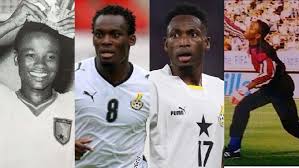
In the beautiful game, talent alone is never enough. Destiny plays a part—but so does luck. And sometimes, luck is cruel. For Ghana, a country that has produced some of Africa’s most dazzling footballers, the cost of injuries has been heartbreakingly high. In this story, we journey through the lives of four extraordinary players—Baba Yara, Michael Essien, Daniel Opare, and Abedi Ayew Pelé—whose careers were either ended, dimmed, or detoured by devastating injuries. Their stories are a haunting reminder of what could have been.
1. Baba Yara – The King of Wingers Whose Reign Was Cut Short
Before there were stadiums bearing his name, there was just a boy from Kumasi who dreamt of greatness. Baba Yara, once a horse jockey, sprinted his way into the hearts of football fans in the late 1950s with Asante Kotoko and the Ghana national team.
He was electrifying—fast, intelligent, and unstoppable on the flanks. By 1960, after a brilliant performance at the Olympic Games in Rome, he was being whispered about across Africa as a legend in the making.
But fate had other plans.
In 1963, while traveling with Kotoko for a match, a car accident changed everything. Yara was left paralyzed from the waist down. He never played again. He never walked again. He died in 1969 at just 33.
Yet, in those brief years, he lit a fire in Ghanaian football that still burns. The Baba Yara Sports Stadium stands as both tribute and tombstone—a reminder of a life and legacy interrupted.
2. Michael Essien – The Bison Who Ran Into the Wall
Few players combined power and precision like Michael Essien. Known as “The Bison,” he dominated midfields for Lyon, Chelsea, and the Black Stars with fearless tackles, lung-bursting runs, and thunderous goals.
He was a cornerstone of Ghana’s golden generation and a Chelsea legend under Mourinho.
But in 2008, disaster struck.
On international duty, Essien tore his cruciate ligament. He came back—but never the same. In 2010, another knee injury ruled him out of Ghana’s historic run to the World Cup quarterfinals in South Africa. The years between 2008 and 2012 saw multiple surgeries, missed seasons, and fading brilliance.
At his peak, Essien was Ballon d’Or material. Injuries denied him that recognition and shortened his time at the top. Yet even diminished, his heart never wavered. He remains a hero—but one whose career was robbed of its full bloom.
3. Daniel Opare – The Wonderkid Who Faded Too Soon
At the 2007 U-17 World Cup, Daniel Opare was hailed as the next big thing. His performances at right-back drew comparisons to Dani Alves. Real Madrid signed him at just 17.
But behind the scenes, Opare was fighting a losing battle with his own body.
Chronic muscle and ankle injuries disrupted his early years in Europe. Clubs like Porto, Standard Liège, and Augsburg saw flashes—but not consistency. Ghana still called him up for the 2014 World Cup, but the boy wonder had already lost his spark.
Now semi-active, Opare’s career is a tale of what might have been. Promise unfulfilled. Potential unclaimed.
4. Abedi Ayew Pelé – The Genius Who Carried Scars
Unlike the others, Abedi Pelé made it. He won the Champions League with Marseille, was named African Footballer of the Year three times, and captained Ghana with pride.
But even he wasn’t spared.
Recurring hamstring and groin injuries plagued key years of his career, especially in the early ’90s. He missed the 1992 AFCON final, where Ghana narrowly lost to Ivory Coast on penalties. Other absences meant missed chances to shine even brighter on the world stage.
Abedi’s legend is secure. Yet there remains the quiet question: Could he have been even greater? A FIFA World Player of the Year nominee? A bigger presence in Europe?
We’ll never know.
Final Whistle: A Legacy of Triumph and Tragedy
The story of Ghanaian football is etched with both glory and grief. Baba Yara’s shattered spine. Essien’s knees. Opare’s ankles. Abedi’s lingering pains. Each injury wasn’t just physical—it was the loss of a chapter never written.
These men remind us that football greatness doesn’t just depend on talent, but on the fragile thread of health. They gave what they could. Sometimes, it wasn’t enough—because fate took the rest.
Yet in the brokenness, they found immortality. Not just as players, but as symbols of resilience, brilliance, and sacrifice.



0 Comments