
In football, a player’s legendary status can be measured in goals, trophies, or individual brilliance. Goals often stand out, as they are the most decisive moments in a match. Players like Cristiano Ronaldo, Erling Haaland, and Yakubu Aiyegbeni are remembered for their scoring prowess, while icons like Ronaldinho Gaúcho and Jay-Jay Okocha are celebrated for their flair and unique style.
In Africa, legendary status is also defined by the impact and visibility a player brings to their country. Longevity and contribution to national pride are key metrics, often just as important as trophies. On the continent, the most coveted prize is the African Cup of Nations (AFCON). Winning it cements a player’s place in history, as Sadio Mané did with Senegal in 2021, securing his legacy as a national hero.
However, some of Africa’s most iconic footballers, despite stellar club and international careers, never won the AFCON. Their legacies are measured by the weight of expectations they carried, the pride they inspired, and the doors they opened for African football globally.
Legendary African Footballers Without an AFCON Trophy
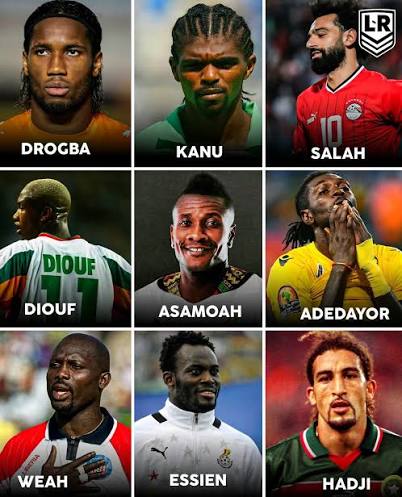
Didier Drogba (Ivory Coast)
More than a footballer, Drogba is a national symbol. He led a golden generation to AFCON finals in 2006 and 2012, but heartbreak struck both times. Beyond football, he helped unite Ivory Coast during conflict, proving his impact extends far beyond goals.
Mohamed Salah (Egypt)
Salah has made Egypt a global footballing force with his achievements in Europe. Yet, despite reaching several AFCON finals, he has not captured the continental trophy, leaving his international story one of near-glory rather than fulfilment.
Asamoah Gyan (Ghana)
Ghana’s all-time top scorer, Gyan carried the Black Stars through multiple tournaments and World Cups. Despite his record-breaking goals, AFCON success eluded him until his retirement in 2023.
George Weah (Liberia)
Africa’s only Ballon d’Or winner, Weah elevated Liberia on the global stage almost single-handedly. Limited national team resources meant AFCON victory was never achieved, but his influence reshaped African football’s perception worldwide.
Pierre-Emerick Aubameyang (Gabon)
Aubameyang led Gabon with skill and flair for years. Despite their struggles in AFCON, his leadership and club success brought global visibility to Gabonese football.
El Hadji Diouf (Senegal)
A two-time African Footballer of the Year, Diouf led Senegal to their first AFCON final in 2002. His confidence, flair, and determination helped announce Senegal as a continental power.
Michael Essien (Ghana)
The engine of Ghana’s golden era in the 2000s, Essien’s power, discipline, and versatility drove the Black Stars to multiple AFCON finals and semi-finals, though victory never came.
Stephen Appiah (Ghana)
Appiah captained Ghana for over a decade, controlling midfield and leading the team through numerous tournaments. Despite his influence, AFCON glory remained out of reach.
Nwankwo Kanu (Nigeria)
“The Papilo” was one of Nigeria’s most elegant forwards. Despite multiple AFCON appearances and World Cup contributions, a continental trophy never materialized. His club success and national impact remain monumental.
Emmanuel Adebayor (Togo)
Togo’s greatest football export, Adebayor carried the nation to its only World Cup in 2006. Limited team strength at AFCON meant he never reached the podium, yet his legacy as a trailblazer for Togolese football is secure.
These players show that legendary status in African football is about more than trophies. Talent, impact, and the pride they inspire often outweigh silverware, proving that greatness is defined in many ways.



0 Comments