
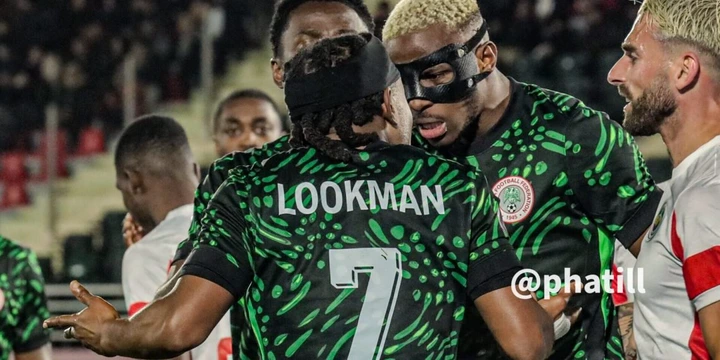
Nigerian football has never lacked talent. What it has often struggled to protect is temperament. Across decades, the country has produced players of astonishing ability—artists whose brilliance lit up stadiums, only to fade far too quickly. Not because they were not good enough, but because discipline, patience, and judgment failed them at crucial moments.
Football folklore has a name for such figures: enfant terrible—talents so gifted that genius and self-destruction seem to coexist within them. Sadly, Nigeria knows this story all too well.
This is not an accusation. It is a warning shaped by history—one that today’s brightest star, Victor Osimhen, cannot afford to ignore.
To understand why restraint matters, one must look back.
In 1979, a 15-year-old boy from Ajegunle signed for Stationery Stores. His name was Tarila Okorowanta, and to those who saw him play, he was pure football magic.
Small in stature but enormous in talent, Tarila could play anywhere across the pitch—winger, playmaker, central midfielder, even a false nine long before the term existed. Coaches trusted him. Fans adored him. Teammates spoke of his effortless brilliance.
He shared the field with Nigerian greats like Austin Fregene, Peter Rufai, and Haruna Ilerika. His résumé sparkled: a Cup Winners’ Cup final appearance in 1981, an FA Cup triumph in 1982, the WAFU Cup in 1984, AFCON silver with Nigeria the same year, and a league title in 1987.
Then came the moment that changed everything.
After scoring four goals in a crushing 7–1 win for Shooting Stars against Mighty Jets, Tarila travelled with the team to Tunisia for a CAF Champions League fixture. On the return journey, he disappeared. He absconded.
He resurfaced in Italy, spent years chasing contracts that never materialized, and later moved to the United States. There, a player once destined for greatness found himself coaching a Grade 7 girls’ team.
The talent never left him. Discipline did.
Another painful chapter belongs to Etim Esin—a footballer so gifted that legendary commentator Ernest Okonkwo dubbed him “The African Maradona.” Esin dazzled for Iwuanyanwu Nationale, Calabar Rovers, Flash Flamingos, and Nigeria’s U-20 side. His skill was unquestionable. His downfall was not.
Time and again, opportunity knocked. Time and again, poor judgment answered.
These stories are not meant to diminish their gifts, but to underline a brutal truth: in Nigerian football history, talent alone has never been enough.
Today, Victor Osimhen stands at the summit—arguably Nigeria’s most valuable footballing asset in generations. His hunger, passion, and intensity are strengths. But history whispers a warning: when emotion runs ahead of control, even the brightest flame can burn out too soon.
Nigeria has seen this movie before. It must not end the same way again.




0 Comments